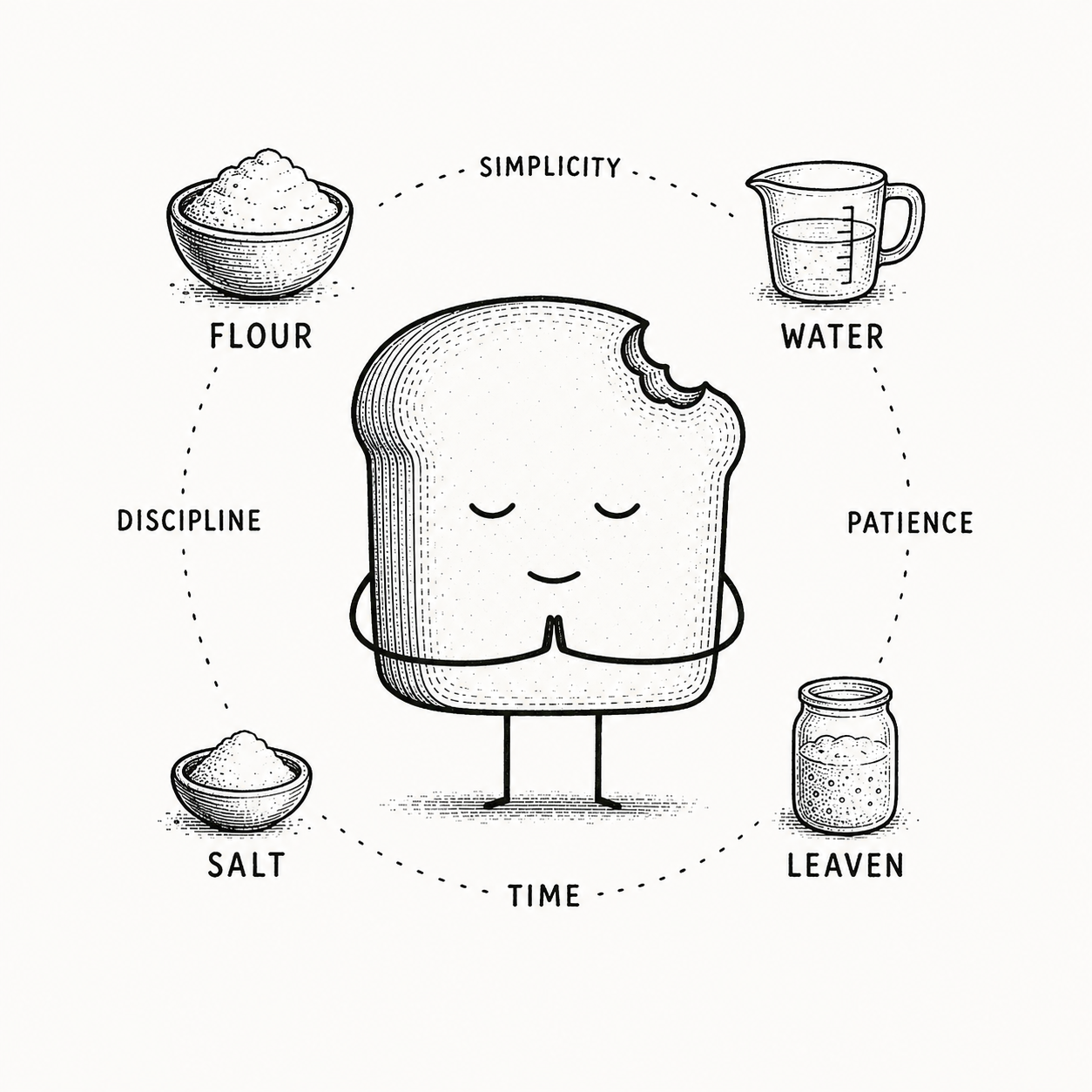
The previous essay introduced the Four Marks. This essay turns them into a practical tool. The eater needs only a small set of observations, performed in order, that take less than thirty seconds at any bakery counter. Four steps: Read, Look, Lift, Smell.
Read. Check the ingredient list. A real loaf has four to seven ingredients, all recognizable as food. A list of fifteen substances, most requiring chemistry training to pronounce, is a confession that the bread was made by industrial method. This single check eliminates ninety percent of the supermarket aisle in seconds.
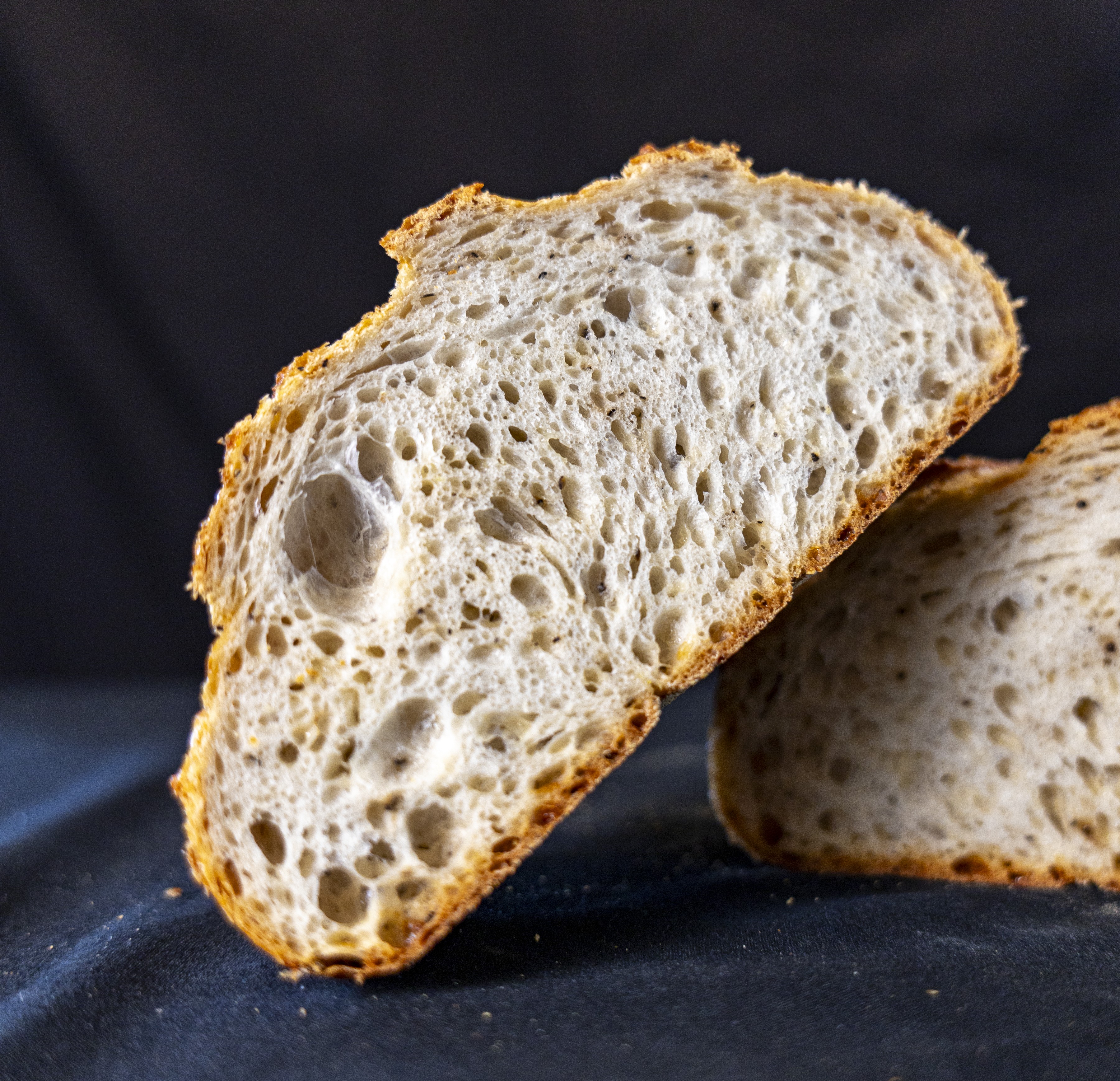
Look. A real loaf shows visible variations: irregular score lines, slight asymmetry, a crust with darker patches, a crumb with gas pockets of varying sizes — some small, some quite large, never uniform. An industrial loaf is uniformly tall, uniformly colored, with crumb that looks identical from one slice to the next.
Lift. Pick the loaf up. A real loaf, of any given size, will be noticeably heavier than an industrial loaf of the same size. The weight comes from density: long fermentation produces a more developed gluten network and bread that has substance. Industrial bread, mixed with twice the yeast and rushed through a fast proof, is lighter because it is more air. The weight test requires no training at all.
Smell. A real loaf has a complex, sweet, slightly fermented, slightly toasted smell that no other food produces. Industrial bread has a faint, generic smell from sugar and chemical browning. Once the eater has compared them directly, the recognition becomes permanent.
Two further checks. The bottom of the loaf will often tell more than the top — a real loaf shows the texture of the surface it baked on; an industrial loaf shows the smooth bottom of a pan. And the score lines: hand-scored slashes vary in depth and angle; stamped scores on industrial bread are identical across every loaf. The skill becomes automatic with practice. The next essay turns to a problem the field guide makes obvious: that the word artisan no longer means anything.
Want the full story?
This is an excerpt. The complete essay is published on Substack.
Read more on Substack